//
//
Technical Insight
Technical Insight
//
//
Why Fine Art Printing Is Not “Just Printing”
Why Fine Art Printing Is Not “Just Printing”
At Arteum, printing is never treated as a commodity. It is treated as a continuation of the artwork itself.
At Arteum, printing is never treated as a commodity. It is treated as a continuation of the artwork itself.
by
Arteum
3
min read
We hear it occasionally. A client, perfectly reasonably, asks: “Can't we just get that printed somewhere?” And the honest answer is yes - you can. But what comes back will not be the same thing. Not even close.
Fine art printing is a discipline, and like most disciplines, the difference between doing it and doing it well is not always obvious until you put two prints side by side. We have been having that conversation for years.
The ink is not the same
Standard commercial printing uses dye-based inks designed for speed, volume, and short-term impact. Archival pigment inks - what we use - work differently. Pigment particles bond directly to the paper surface rather than sitting on top of it, producing measurably greater colour stability, depth, and longevity. Leading archival ratings exceed 200 years under museum display conditions. For a work going into a private residence, a luxury hotel, or a cultural institution, that distinction is not academic; it is the whole point.
Paper is a creative decision
This is the part people underestimate. We print on a carefully curated range of Hahnemühle fine art papers, a manufacturer with roots going back to 1584, and the choice of surface changes everything. A baryta paper and a cotton rag paper will render the same image completely differently in terms of tone, texture, and presence. We test before we commit. Paper selection at Arteum is never assumed. It is discussed, sampled, and confirmed, because getting it wrong changes the entire work.
Colour can’t be hoped for
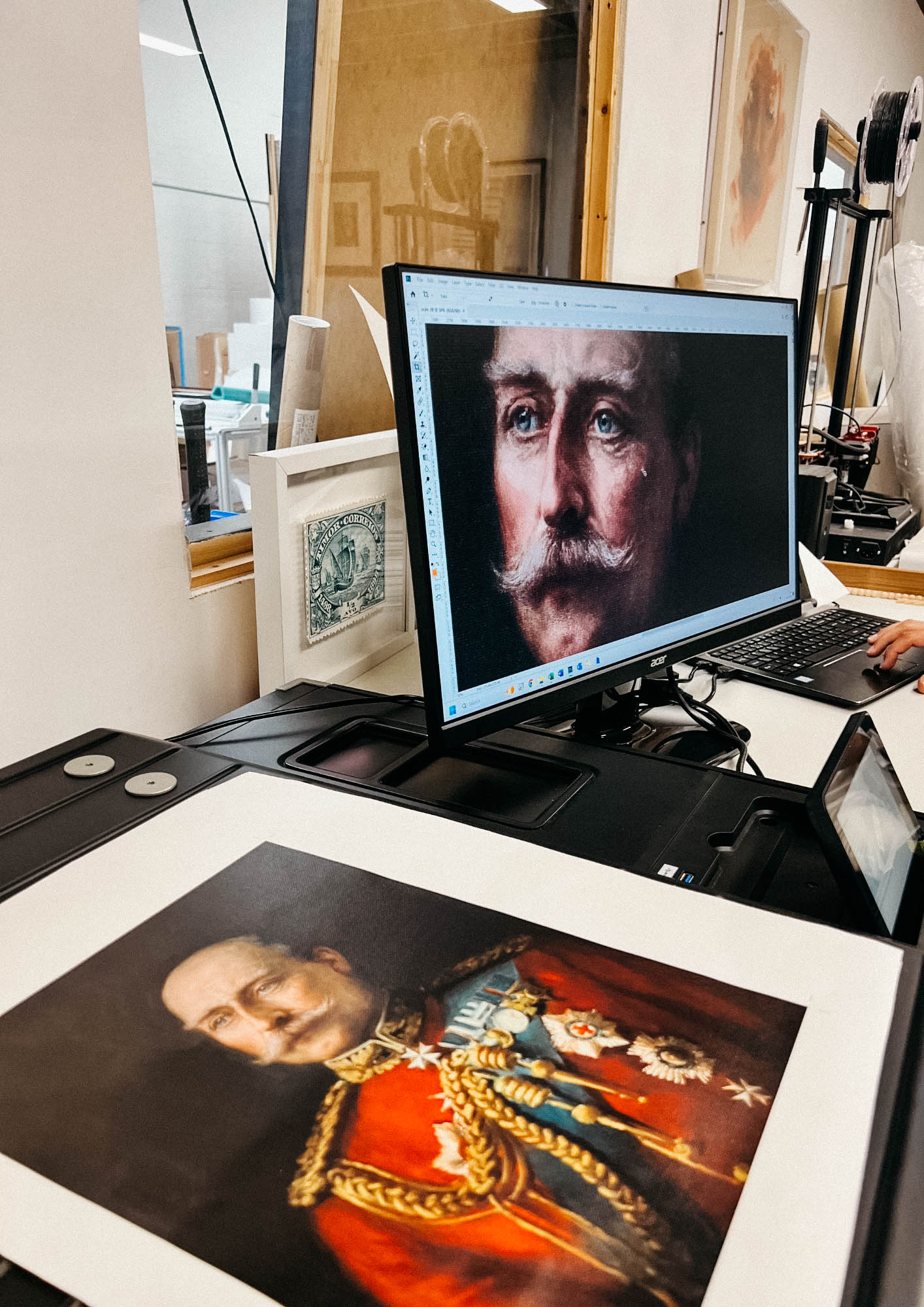
No two output devices reproduce colour the same way. Without rigorous management, what begins as a rich, carefully balanced image can arrive cooler, flatter, or simply off. We use spectrophotometer-based colour measurement and calibrated ICC profiles at every stage, meaning colour is not approximated; it is fully controlled. This is especially critical across large schemes. Producing hundreds of prints for a hotel and achieving complete consistency across all of them does not happen by default. It is the result of a system built and maintained with precision.
And then, there is the eye
We produce archival pigment prints on 12-colour Canon large-format printers. Twelve colours, rather than the standard four or six, allows for an extended gamut: richer midtones, deeper shadows, more faithful reproduction of nuanced colour. But equipment alone is never enough. Every print that leaves our studio is reviewed by someone who knows what the image is supposed to look like, and who has the experience to know when it does not. That final moment of human judgement is not a formality!
Fine art printing requires the right materials, calibrated processes, and informed eyes working together. Take any one of those away, and it becomes something else entirely.
“Just printing.”
We hear it occasionally. A client, perfectly reasonably, asks: “Can't we just get that printed somewhere?” And the honest answer is yes - you can. But what comes back will not be the same thing. Not even close.
Fine art printing is a discipline, and like most disciplines, the difference between doing it and doing it well is not always obvious until you put two prints side by side. We have been having that conversation for years.
The ink is not the same
Standard commercial printing uses dye-based inks designed for speed, volume, and short-term impact. Archival pigment inks - what we use - work differently. Pigment particles bond directly to the paper surface rather than sitting on top of it, producing measurably greater colour stability, depth, and longevity. Leading archival ratings exceed 200 years under museum display conditions. For a work going into a private residence, a luxury hotel, or a cultural institution, that distinction is not academic; it is the whole point.
Paper is a creative decision
This is the part people underestimate. We print on a carefully curated range of Hahnemühle fine art papers, a manufacturer with roots going back to 1584, and the choice of surface changes everything. A baryta paper and a cotton rag paper will render the same image completely differently in terms of tone, texture, and presence. We test before we commit. Paper selection at Arteum is never assumed. It is discussed, sampled, and confirmed, because getting it wrong changes the entire work.
Colour can’t be hoped for
No two output devices reproduce colour the same way. Without rigorous management, what begins as a rich, carefully balanced image can arrive cooler, flatter, or simply off. We use spectrophotometer-based colour measurement and calibrated ICC profiles at every stage, meaning colour is not approximated; it is fully controlled. This is especially critical across large schemes. Producing hundreds of prints for a hotel and achieving complete consistency across all of them does not happen by default. It is the result of a system built and maintained with precision.
And then, there is the eye
We produce archival pigment prints on 12-colour Canon large-format printers. Twelve colours, rather than the standard four or six, allows for an extended gamut: richer midtones, deeper shadows, more faithful reproduction of nuanced colour. But equipment alone is never enough. Every print that leaves our studio is reviewed by someone who knows what the image is supposed to look like, and who has the experience to know when it does not. That final moment of human judgement is not a formality!
Fine art printing requires the right materials, calibrated processes, and informed eyes working together. Take any one of those away, and it becomes something else entirely.
“Just printing.”
MORE TO READ
//
Technical Insight
//
Why Fine Art Printing Is Not “Just Printing”
At Arteum, printing is never treated as a commodity. It is treated as a continuation of the artwork itself.
by
Arteum
3
min read
We hear it occasionally. A client, perfectly reasonably, asks: “Can't we just get that printed somewhere?” And the honest answer is yes - you can. But what comes back will not be the same thing. Not even close.
Fine art printing is a discipline, and like most disciplines, the difference between doing it and doing it well is not always obvious until you put two prints side by side. We have been having that conversation for years.
The ink is not the same
Standard commercial printing uses dye-based inks designed for speed, volume, and short-term impact. Archival pigment inks - what we use - work differently. Pigment particles bond directly to the paper surface rather than sitting on top of it, producing measurably greater colour stability, depth, and longevity. Leading archival ratings exceed 200 years under museum display conditions. For a work going into a private residence, a luxury hotel, or a cultural institution, that distinction is not academic; it is the whole point.
Paper is a creative decision
This is the part people underestimate. We print on a carefully curated range of Hahnemühle fine art papers, a manufacturer with roots going back to 1584, and the choice of surface changes everything. A baryta paper and a cotton rag paper will render the same image completely differently in terms of tone, texture, and presence. We test before we commit. Paper selection at Arteum is never assumed. It is discussed, sampled, and confirmed, because getting it wrong changes the entire work.
Colour can’t be hoped for
No two output devices reproduce colour the same way. Without rigorous management, what begins as a rich, carefully balanced image can arrive cooler, flatter, or simply off. We use spectrophotometer-based colour measurement and calibrated ICC profiles at every stage, meaning colour is not approximated; it is fully controlled. This is especially critical across large schemes. Producing hundreds of prints for a hotel and achieving complete consistency across all of them does not happen by default. It is the result of a system built and maintained with precision.
And then, there is the eye
We produce archival pigment prints on 12-colour Canon large-format printers. Twelve colours, rather than the standard four or six, allows for an extended gamut: richer midtones, deeper shadows, more faithful reproduction of nuanced colour. But equipment alone is never enough. Every print that leaves our studio is reviewed by someone who knows what the image is supposed to look like, and who has the experience to know when it does not. That final moment of human judgement is not a formality!
Fine art printing requires the right materials, calibrated processes, and informed eyes working together. Take any one of those away, and it becomes something else entirely.
“Just printing.”