//
//
Work
Work
//
//
Behind the Scenes: Hilton Park Lane, London
Behind the Scenes: Hilton Park Lane, London
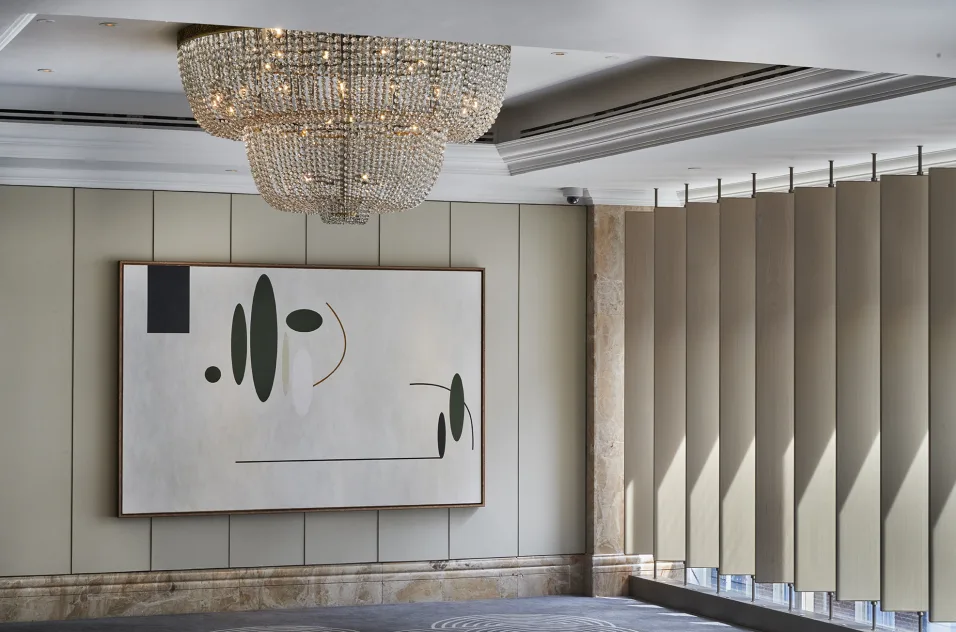
Over 900 artworks. 450 rooms. 36 weeks. And a framing specification that demanded something we had not done quite the same way before.
Over 900 artworks. 450 rooms. 36 weeks. And a framing specification that demanded something we had not done quite the same way before.
by
Arteum
3
min read
Let’s dive into the Hilton Park Lane refurbishment project.
The brief that set the tone
From the outset, we knew this was not a project where standard solutions would work. The design team had developed a custom furniture scheme with a very specific tone: a warm, considered timber finish that ran consistently across all rooms and public areas. Every framed work and mirror in the hotel needed to align with it precisely.
That meant the frames could not simply be ordered from a supplier's catalogue. They had to be developed from scratch, with timber mouldings carefully selected, graded, and finished to a custom stain mix that we formulated specifically for this project. Getting that match right across more than 600 bespoke frames was the central challenge, and the one we spent the most time on before a single artwork went to press.
Building the system
A project at this scale is only as good as the production system behind it. With 450 rooms each requiring framed works, large-format canvases, and in some cases mirrors, the margin for inconsistency was considerable. A finish that drifts slightly between batches, a canvas tension that varies across a run, a stain mix that reads differently under different lighting - any of these, multiplied across hundreds of pieces, becomes visible and problematic.
We built the workflow to prevent exactly that. Timber was graded before production began. Stain batches were tested and locked. Canvas prints (more than 300 of them, some reaching up to 2m x 1m) were printed, mounted, and sealed with a matte varnish to a consistent specification throughout. Every element was reviewed before it left the studio.
Delivery across 36 weeks
Phased delivery on a live hotel refurbishment is a logistical discipline in its own right. Rooms complete at different times, floors are handed over in sequence, and the installation team needs the right works in the right place at the right moment. Arriving early is almost as disruptive as arriving late.
We structured delivery in close alignment with the site programme, ensuring each phase arrived precisely when the installation team needed it; labelled, sequenced, and ready to go. No searching through crates. No cross-referencing spreadsheets on site. Just works, in order, ready for the wall.
What we took from it
The Hilton Park Lane project demanded consistency at a scale that leaves nowhere to hide, and a level of material development that pushed our framing capability in a direction we have drawn on many times since.
When the last room was signed off and the final works were in place, the finish read as one continuous, considered scheme across the entire hotel. That coherence is what the project was always about.
Let’s dive into the Hilton Park Lane refurbishment project.
The brief that set the tone
From the outset, we knew this was not a project where standard solutions would work. The design team had developed a custom furniture scheme with a very specific tone: a warm, considered timber finish that ran consistently across all rooms and public areas. Every framed work and mirror in the hotel needed to align with it precisely.
That meant the frames could not simply be ordered from a supplier's catalogue. They had to be developed from scratch, with timber mouldings carefully selected, graded, and finished to a custom stain mix that we formulated specifically for this project. Getting that match right across more than 600 bespoke frames was the central challenge, and the one we spent the most time on before a single artwork went to press.
Building the system
A project at this scale is only as good as the production system behind it. With 450 rooms each requiring framed works, large-format canvases, and in some cases mirrors, the margin for inconsistency was considerable. A finish that drifts slightly between batches, a canvas tension that varies across a run, a stain mix that reads differently under different lighting - any of these, multiplied across hundreds of pieces, becomes visible and problematic.
We built the workflow to prevent exactly that. Timber was graded before production began. Stain batches were tested and locked. Canvas prints (more than 300 of them, some reaching up to 2m x 1m) were printed, mounted, and sealed with a matte varnish to a consistent specification throughout. Every element was reviewed before it left the studio.
Delivery across 36 weeks
Phased delivery on a live hotel refurbishment is a logistical discipline in its own right. Rooms complete at different times, floors are handed over in sequence, and the installation team needs the right works in the right place at the right moment. Arriving early is almost as disruptive as arriving late.
We structured delivery in close alignment with the site programme, ensuring each phase arrived precisely when the installation team needed it; labelled, sequenced, and ready to go. No searching through crates. No cross-referencing spreadsheets on site. Just works, in order, ready for the wall.
What we took from it
The Hilton Park Lane project demanded consistency at a scale that leaves nowhere to hide, and a level of material development that pushed our framing capability in a direction we have drawn on many times since.
When the last room was signed off and the final works were in place, the finish read as one continuous, considered scheme across the entire hotel. That coherence is what the project was always about.
MORE TO READ
//
Work
//
Behind the Scenes: Hilton Park Lane, London
Over 900 artworks. 450 rooms. 36 weeks. And a framing specification that demanded something we had not done quite the same way before.
by
Arteum
3
min read
Let’s dive into the Hilton Park Lane refurbishment project.
The brief that set the tone
From the outset, we knew this was not a project where standard solutions would work. The design team had developed a custom furniture scheme with a very specific tone: a warm, considered timber finish that ran consistently across all rooms and public areas. Every framed work and mirror in the hotel needed to align with it precisely.
That meant the frames could not simply be ordered from a supplier's catalogue. They had to be developed from scratch, with timber mouldings carefully selected, graded, and finished to a custom stain mix that we formulated specifically for this project. Getting that match right across more than 600 bespoke frames was the central challenge, and the one we spent the most time on before a single artwork went to press.
Building the system
A project at this scale is only as good as the production system behind it. With 450 rooms each requiring framed works, large-format canvases, and in some cases mirrors, the margin for inconsistency was considerable. A finish that drifts slightly between batches, a canvas tension that varies across a run, a stain mix that reads differently under different lighting - any of these, multiplied across hundreds of pieces, becomes visible and problematic.
We built the workflow to prevent exactly that. Timber was graded before production began. Stain batches were tested and locked. Canvas prints (more than 300 of them, some reaching up to 2m x 1m) were printed, mounted, and sealed with a matte varnish to a consistent specification throughout. Every element was reviewed before it left the studio.
Delivery across 36 weeks
Phased delivery on a live hotel refurbishment is a logistical discipline in its own right. Rooms complete at different times, floors are handed over in sequence, and the installation team needs the right works in the right place at the right moment. Arriving early is almost as disruptive as arriving late.
We structured delivery in close alignment with the site programme, ensuring each phase arrived precisely when the installation team needed it; labelled, sequenced, and ready to go. No searching through crates. No cross-referencing spreadsheets on site. Just works, in order, ready for the wall.
What we took from it
The Hilton Park Lane project demanded consistency at a scale that leaves nowhere to hide, and a level of material development that pushed our framing capability in a direction we have drawn on many times since.
When the last room was signed off and the final works were in place, the finish read as one continuous, considered scheme across the entire hotel. That coherence is what the project was always about.