//
//
Technical Insight
Technical Insight
//
//
From Original to Archive
From Original to Archive
At Arteum, scanning is treated as an act of preservation, not convenience.
At Arteum, scanning is treated as an act of preservation, not convenience.
by
Arteum
3
min read
Ask most people where fine art reproduction begins and they will say the printer. In our experience, it begins long before that: at the moment of capture. Get that stage wrong, and no amount of archival ink or museum-grade paper will save what follows. Get it right, and everything else becomes possible.
Scanning and digitisation are the foundation of faithful reproduction. They are also the stage most likely to be underestimated.
Not all capture is equal
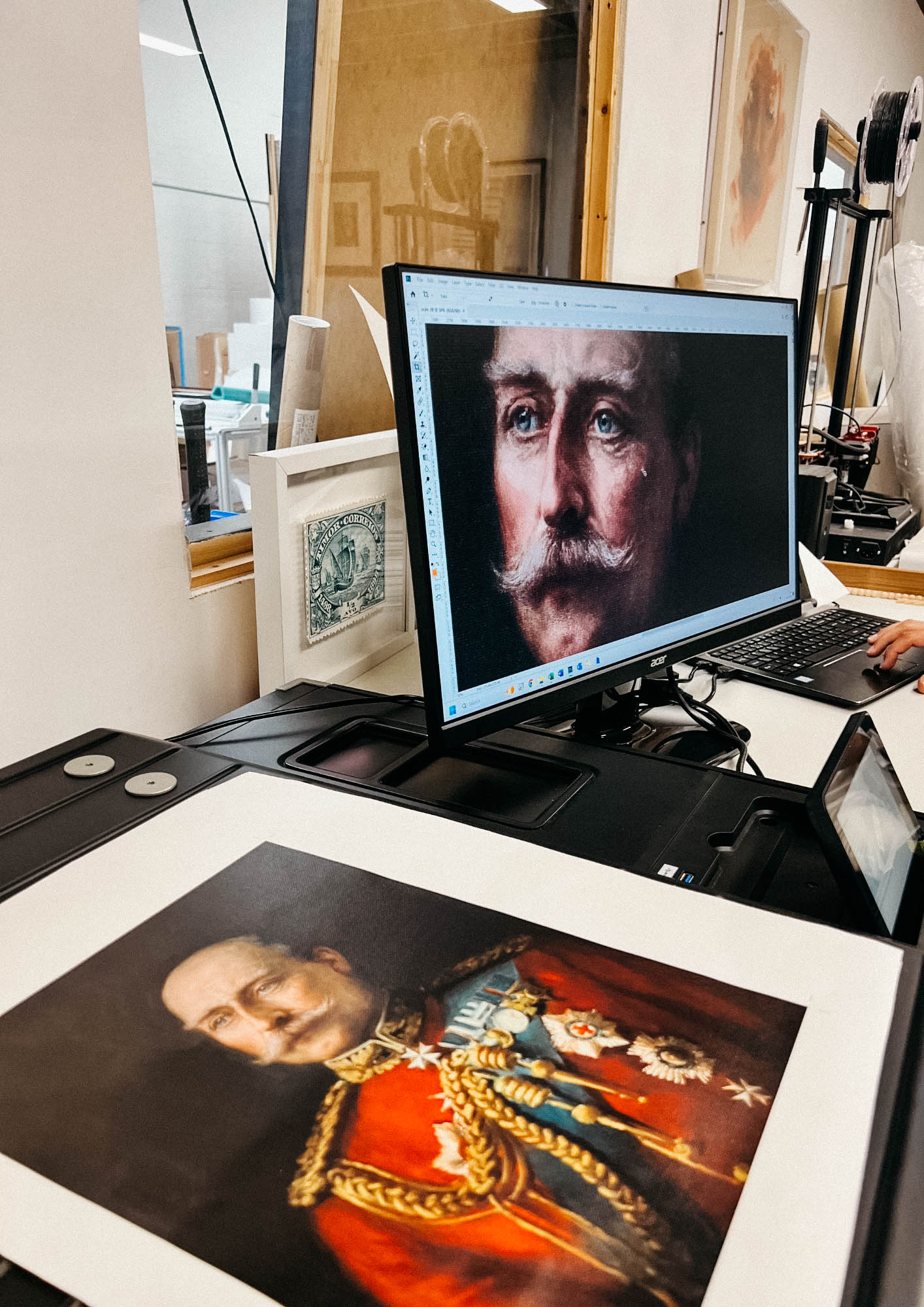
Original artworks are not flat, uniform objects. A painting carries surface texture, impasto, varnish, and a physical presence that a standard flatbed scan will simply miss. A large-scale work cannot be captured whole on most scanning systems. A fragile work on paper may not tolerate direct contact at all.
We use advanced wide-format and 3D scanning systems capable of recording not just colour and tone, but the physical character of the surface itself: the grain of the canvas, the build of the brushstroke, the subtle irregularities that make an original what it is. Where scanning is not appropriate due to scale, fragility, or material complexity, we capture through high-resolution photographic digitisation. The method is chosen to suit the work, and the standard never changes.
Colour is where most processes fail
Capturing an image and capturing its colour faithfully are two entirely different things. A photograph of a painting taken without colour management will look broadly similar to the original. It will not be true to it, and in fine art reproduction, broadly similar is not good enough.
We use spectrophotometer-based colour measurement at the point of capture, establishing a precise colour profile that travels with the file throughout its entire production life. Whether a print is made immediately or revisited two years later, whether it is produced at our London facility or our workshop in Portugal, the relationship to the original is maintained. Not approximated. Maintained.
The file is the archive
Once captured and colour-managed, the digital file becomes something genuinely valuable: a faithful, permanent record of the work that can serve it for decades. Reproduced at any scale, across any format, for any environment, without returning to the original each time.
We treat every file with that responsibility in mind. Files are refined, and never altered. Where age, damage, or deterioration is present, it is addressed carefully and only where appropriate. The integrity of the work is never compromised in the process.
When it comes together
There is a particular moment we never tire of - when a client holds a finished print alongside the original and finds it genuinely difficult to articulate the difference. It is the result of capture carried out with precision, colour managed with rigour, and a file prepared with the final output firmly in mind from the very beginning.
Scanning is not a preliminary step. It is where the work of reproduction truly begins.
Ask most people where fine art reproduction begins and they will say the printer. In our experience, it begins long before that: at the moment of capture. Get that stage wrong, and no amount of archival ink or museum-grade paper will save what follows. Get it right, and everything else becomes possible.
Scanning and digitisation are the foundation of faithful reproduction. They are also the stage most likely to be underestimated.
Not all capture is equal
Original artworks are not flat, uniform objects. A painting carries surface texture, impasto, varnish, and a physical presence that a standard flatbed scan will simply miss. A large-scale work cannot be captured whole on most scanning systems. A fragile work on paper may not tolerate direct contact at all.
We use advanced wide-format and 3D scanning systems capable of recording not just colour and tone, but the physical character of the surface itself: the grain of the canvas, the build of the brushstroke, the subtle irregularities that make an original what it is. Where scanning is not appropriate due to scale, fragility, or material complexity, we capture through high-resolution photographic digitisation. The method is chosen to suit the work, and the standard never changes.
Colour is where most processes fail
Capturing an image and capturing its colour faithfully are two entirely different things. A photograph of a painting taken without colour management will look broadly similar to the original. It will not be true to it, and in fine art reproduction, broadly similar is not good enough.
We use spectrophotometer-based colour measurement at the point of capture, establishing a precise colour profile that travels with the file throughout its entire production life. Whether a print is made immediately or revisited two years later, whether it is produced at our London facility or our workshop in Portugal, the relationship to the original is maintained. Not approximated. Maintained.
The file is the archive
Once captured and colour-managed, the digital file becomes something genuinely valuable: a faithful, permanent record of the work that can serve it for decades. Reproduced at any scale, across any format, for any environment, without returning to the original each time.
We treat every file with that responsibility in mind. Files are refined, and never altered. Where age, damage, or deterioration is present, it is addressed carefully and only where appropriate. The integrity of the work is never compromised in the process.
When it comes together
There is a particular moment we never tire of - when a client holds a finished print alongside the original and finds it genuinely difficult to articulate the difference. It is the result of capture carried out with precision, colour managed with rigour, and a file prepared with the final output firmly in mind from the very beginning.
Scanning is not a preliminary step. It is where the work of reproduction truly begins.
MORE TO READ
//
Technical Insight
//
From Original to Archive
At Arteum, scanning is treated as an act of preservation, not convenience.
by
Arteum
3
min read
Ask most people where fine art reproduction begins and they will say the printer. In our experience, it begins long before that: at the moment of capture. Get that stage wrong, and no amount of archival ink or museum-grade paper will save what follows. Get it right, and everything else becomes possible.
Scanning and digitisation are the foundation of faithful reproduction. They are also the stage most likely to be underestimated.
Not all capture is equal
Original artworks are not flat, uniform objects. A painting carries surface texture, impasto, varnish, and a physical presence that a standard flatbed scan will simply miss. A large-scale work cannot be captured whole on most scanning systems. A fragile work on paper may not tolerate direct contact at all.
We use advanced wide-format and 3D scanning systems capable of recording not just colour and tone, but the physical character of the surface itself: the grain of the canvas, the build of the brushstroke, the subtle irregularities that make an original what it is. Where scanning is not appropriate due to scale, fragility, or material complexity, we capture through high-resolution photographic digitisation. The method is chosen to suit the work, and the standard never changes.
Colour is where most processes fail
Capturing an image and capturing its colour faithfully are two entirely different things. A photograph of a painting taken without colour management will look broadly similar to the original. It will not be true to it, and in fine art reproduction, broadly similar is not good enough.
We use spectrophotometer-based colour measurement at the point of capture, establishing a precise colour profile that travels with the file throughout its entire production life. Whether a print is made immediately or revisited two years later, whether it is produced at our London facility or our workshop in Portugal, the relationship to the original is maintained. Not approximated. Maintained.
The file is the archive
Once captured and colour-managed, the digital file becomes something genuinely valuable: a faithful, permanent record of the work that can serve it for decades. Reproduced at any scale, across any format, for any environment, without returning to the original each time.
We treat every file with that responsibility in mind. Files are refined, and never altered. Where age, damage, or deterioration is present, it is addressed carefully and only where appropriate. The integrity of the work is never compromised in the process.
When it comes together
There is a particular moment we never tire of - when a client holds a finished print alongside the original and finds it genuinely difficult to articulate the difference. It is the result of capture carried out with precision, colour managed with rigour, and a file prepared with the final output firmly in mind from the very beginning.
Scanning is not a preliminary step. It is where the work of reproduction truly begins.